Caroline’s Blog
Introductory Blog Post
Hello everyone! My name is Caroline and I am a Public Relations major at Hofstra University. My hometown is Birmingham, AL, but I am currently kicking it here on Long Island. Currently I am on the softball team here at Hofstra which is NCAA D1. Women in sports is my main journalism focus, and more specifically a deeper look into the softball community.
Follow My Blog
Get new content delivered directly to your inbox.
Crowd Sourcing on the Coronavirus Results
The Coronavirus in encroaching on the United States, and this has caused moral panic among citizens. Media plays an influential role in impacting the public’s perception of the Coronavirus. Media is the first wave where the majority of people hear about the novel Covid-19 as it takes over headlines on major news sources daily. The coronavirus is having many impacts on the economy, and environment, etc this is showing in even the pollution in China.
The survey I conducted was aimed to measure how media has influenced the public I have access to and get a better understanding for how media is impacting them based on a few factors. The most important factors in my survey were how often the participant heard about Coronavirus, where they get their news, and if they have a serious concern of the Coronavirus. The results overwhelmingly represented that people hear about Covid-19 at least once a week, and still around half hear about it multiple times a day. The most popular news sources used were Fox, Twitter, CNN, and NBC news and interestingly enough Tik-Tok became a popular answer as well. Most importantly the goal of the research was to measure public perception, and 66 of the votes showed little concern for Covid-19 impacting them, and 34 participants do have a fear of the virus.
The virus is spreading in the United States and globally, and infiltrates the news on a daily basis; this alone impacts public perception, and currently the attitude seems concerned but not fearful.
http://
Satellite images released by NASA and the European Space Agency reveal that air pollution over China has gone down since the coronavirus outbreak https://t.co/3YGAeyrIRZ
— CNN (@CNN) March 2, 2020

Crowd Sourcing on the Coronavirus
The process I went through to obtain information on public perception of the Coronavirus was by creating a Google form survey. The survey consisted of five questions. Have you heard of the Coronavirus, where did you hear about the Coronavirus, how often do you hear about the Coronavirus, and do you have a fear of it impacting you? These were all questions I found essential to understanding the medias impact on public perception of the virus. Overwhelmingly everyone who has taken my survey has heard of the Coronavirus, which speaks multitudes for the impact that social media and cellphones have done for keeping society in the loop. Also interestingly enough a lot of my survey pool gets their information from social media, so it will be interesting to see if that affects the results. I spread my survey around on social media like Twitter, Instagram, GroupMe, Snapchat, and even had friends share the links in groups located in a different region of the United States. I’ve received a lot of engagement so far and hope it continues to grow for more insight into peoples thoughts on the Coronavirus.
Americans Perception of the Media Post
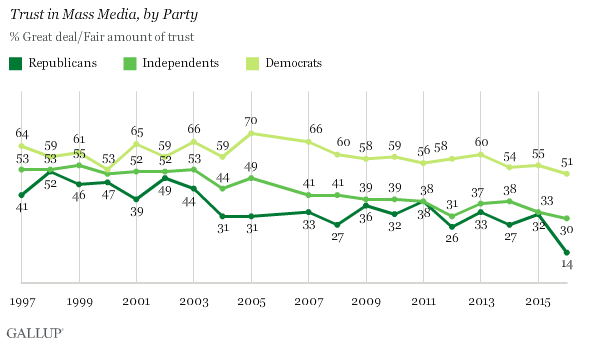
American’s trust in the media has steadily declined since the 1990s; the Gallup survey aims to understand the demographics of those who are being affected by the media. Politics are fuel to the fire when it comes to building distrust in the media due to their tendencies to grab onto the most appealing headlines and stories even if they are not an accurate reflection of the situation. The goal of reporters nowadays seems less focused on objective reporting and more focused on who can put out the most interesting information as quickly as possible. This is a dangerous game for the media because their platform relies on engagement, therefore they should be more focused on how to earn their audience back. Since the explosion of mass media, blogs, social media, etc personalized niche opinionated information has come to light. There is so much information out there in this technology era, and large news corporations have the opportunity to regulate the type of information being put out, but now they seem to be reporting the most eye-catching thing not necessarily the most objective piece. I think it is time for big news cooperations to leave the bias and opinionated news to the smaller journalist to help build more trust in major news outlets again. The continuing decline should cause more of a reaction from the major news services to help retain their audience, and the continued outpour of “mainstream media” could be causing further distrust in the media. The media is interconnected with the audience and if they continue to ignore the call that the news being put out is sufficient it will continue to burden journalism and media. The movement to regain the trust of the public will require some internal reflection and perhaps listening to reasons given by Republicans and younger populations as to why there has been such a steep decline and how to repair that division
https://news.gallup.com/poll/195542/americans-trust-mass-media-sinks-new-low.aspx
 Caroline's Journalism Blog